
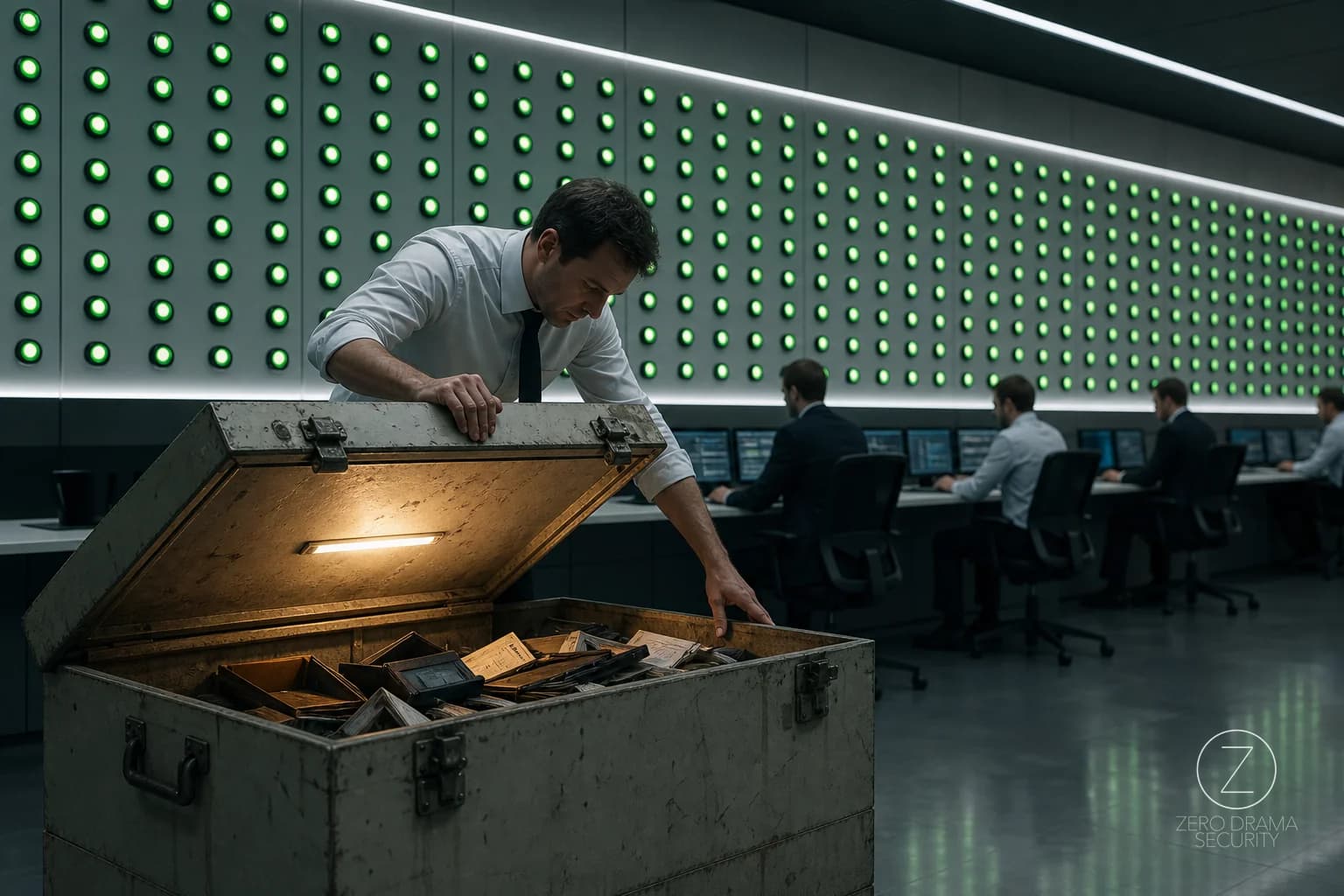
A green dashboard can be useful. It can also be a very polished way to say nothing important failed loudly enough to be noticed.
That distinction gets lost in a lot of security and GRC automation programs. A job ran. A backup completed. A scanner finished. A notification was sent. A ticket moved. A workflow posted a summary. Everyone gets the warm glow of operational motion.
But a completed workflow is not the same thing as a working control.
Security leaders need to be a little rude about this, in a constructive way. When someone says a control is monitored, ask what the green state actually proves. If the answer is “the job completed successfully”, you may only be monitoring the plumbing.
Completion is not control evidence
Many security controls depend on scheduled jobs, integrations, scripts, APIs, exports, scanners, pipelines, and notification paths. That is normal. Modern security operations are stitched together from systems that call other systems.
The mistake is treating the operational success of that machinery as the control outcome.
A backup job completing does not prove restore readiness. It proves a backup process produced something. A vulnerability scan completing does not prove remediation is happening. It proves the scanner ran. An access review campaign closing does not prove inappropriate access was removed. It proves reviewers clicked through the process. A policy acknowledgement workflow finishing does not prove people changed behavior. It proves the acknowledgement was collected.
None of those signals are useless. They are necessary lower level facts. The problem starts when they get promoted into assurance.
This is where dashboards become dangerous. Not because dashboards are bad, but because green compresses too much meaning into one color.
Green can mean the job ran. Green can mean the alert was delivered. Green can mean the expected record was created. Green can mean the risk condition was checked and found acceptable. Green can mean someone acted on a failed condition.
Those are very different claims.
Separate the system signal from the risk signal
A practical control monitoring design should split evidence into layers.
First, did the mechanism run? This is the operational signal. The scheduled job started, completed, wrote logs, reached its destination, or sent the notification.
Second, did the mechanism inspect the thing the control is supposed to govern? This is the scope signal. The job did not just run. It covered the right systems, tenants, environments, repositories, identities, vendors, data stores, or workflows.
Third, did the control condition pass or fail? This is the risk signal. The check found whether privileged access, expired data, exposed secrets, missing logs, unapproved integrations, or policy exceptions existed.
Fourth, when the condition failed, did someone with authority act? This is the accountability signal. A failure that creates a ticket nobody owns is not a monitored control. It is delayed disappointment with timestamps.
That separation sounds obvious until you inspect real control evidence. Many programs have the first layer and call it done. Some have the first two. Fewer can show the full chain from mechanism to scope to condition to decision.
This is also why continuous controls monitoring can create noise before assurance. More signals do not automatically mean better control. Sometimes they just mean the organization has automated its uncertainty.
Notifications are not ownership
There is another trap: confusing message delivery with action.
A notification sent to chat, email, a ticket queue, or an incident channel proves delivery at best. It does not prove the right person saw it, understood it, had authority to act, made a decision, or completed the fix.
This gets especially messy when the control failure is cross functional. Security can detect the issue. IT may own the platform. Engineering may own the system. Legal may own the retention rule. The business may own the risk decision. Procurement may own the vendor relationship.
A green “notification sent” flag hides that governance reality.
For executive reporting, this is a subtle but important tradeoff. Leaders want simple status. Operators need truthful status. If the reporting layer collapses delivery, ownership, and resolution into one green state, the company gets simplicity by spending down accuracy.
A better executive view does not need more noise. It needs cleaner claims.
Say: “Monitoring job completed, two out of scope assets detected, owner assigned, remediation overdue.”
Not: “Control healthy.”
The control is the decision path
For many controls, the actual risk reduction happens after detection.
A scanner does not reduce risk until findings are triaged and fixed or consciously accepted. A backup does not reduce resilience risk until restore is tested. A logging pipeline does not help investigations unless the right events are captured, retained, searchable, and reviewed when needed. An access certification does not protect anything unless inappropriate access is removed.
The control is not just the tool. It is the decision path around the tool.
That means monitoring has to include the handoff points. Who receives the exception? Who can approve risk acceptance? Who can force remediation? What happens when the owner is missing? What evidence survives after the chat thread, meeting, or ticket comment disappears?
If decisions stay informal, control evidence gets brittle. ZDS has covered this before in Security Evidence Fails When Decisions Live in Chat. The same principle applies here: monitoring without durable decisions is mostly activity capture.
What to ask before trusting the dashboard
Before leadership accepts a green control status, ask five questions.
What exact risk condition does this control test?
Which assets, identities, systems, vendors, data stores, or workflows are in scope?
What evidence proves the check covered that scope?
What happens when the condition fails?
Who is accountable for action, and what proves action happened?
If those questions cannot be answered without opening three tools, asking two teams, and searching old messages, the dashboard is probably ahead of the operating model.
That does not mean the program is broken. It means the control needs sharper evidence design.
Green should earn trust
The goal is not to make every dashboard red or bury teams in audit theater. The goal is to make green mean something specific.
Green should mean the mechanism ran, the right scope was checked, the condition passed, or a failed condition was handled within the agreed decision path. If green only means the automation did not crash, label it that way.
Security teams earn credibility when they name the difference.
If your organization is trying to clean up control monitoring, evidence design, or security governance without turning it into a giant process tax, Zero Drama Security services can help shape the operating model.
A dashboard is allowed to be simple. The claims behind it cannot be sloppy.