
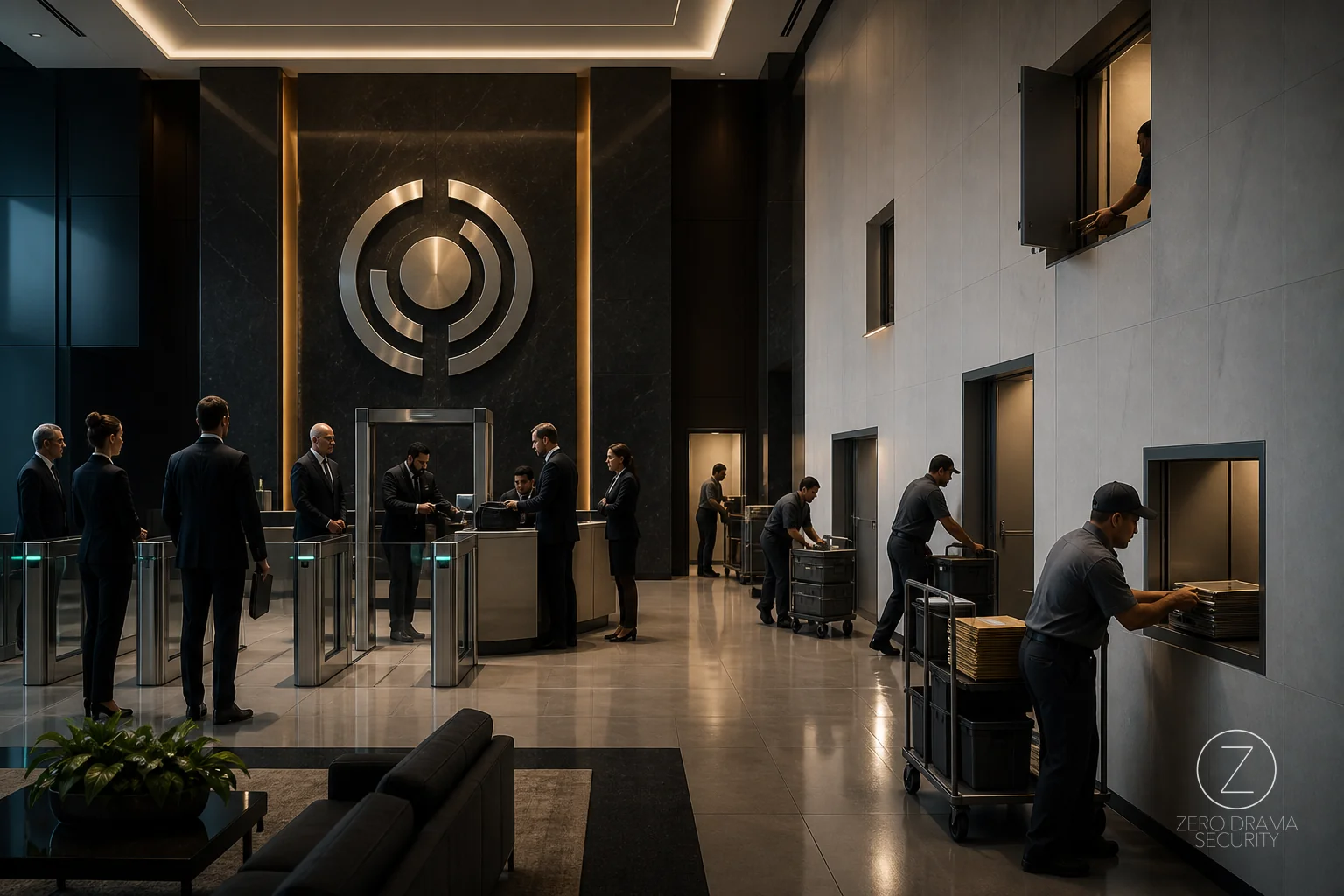
The clean path gets the meeting.
The login flow. The primary database boundary. The official approval screen. The production architecture diagram. The incident dashboard. These are the places security programs like to inspect because they look like the system.
This week was about the other places.
The reset path. The tenant helper job. The human review queue. The AI telemetry stream. The places people call exceptions, plumbing, fallback, evidence, or operational detail. They sound secondary until they move authority, expose data, or decide what the organization can prove later.
That is the pattern across this week’s Zero Drama Security notes: edge cases are not edge cases when they can change production reality.
Recovery is not a support feature
Password reset is still too often treated as a help desk concern with a security wrapper. A user forgets a password, receives a link, proves something, and gets back in. The interface may look simple. The authority behind it is not.
In Password Reset Is Part of the Control Plane, the point was straightforward: password reset, account recovery, MFA reset, email address changes, device re enrollment, session revocation, and emergency admin recovery all belong in the identity control plane.
A recent security item in RC9 telemetry referenced a Keycloak password reset flaw pattern that could allow unauthenticated account takeover. The product name is less important than the lesson. Recovery paths often have as much power as the login path, but they get less design attention because they are treated as rare.
That is backwards. Recovery is used when normal authentication is broken, unavailable, or inconvenient. It is authority under stress.
The control questions are not only “does the reset link expire?” They are better framed as:
- Who can initiate recovery?
- What proof is accepted, and where does that proof come from?
- What sessions survive recovery?
- Can MFA be reset independently of the account owner?
- Who can see or override the process?
- What evidence exists after the account comes back to life?
If those questions do not have crisp answers, the reset flow is not a small feature. It is an alternate front door with softer lighting.
Tenant isolation has to survive the product
Tenant isolation also gets over credited in architecture reviews. Separate tenant IDs. Scoped queries. Shared services. Maybe regional partitions. Maybe separate databases for certain customers. The diagram looks responsible.
Then the product keeps evolving.
Tenant Isolation Is a Product Control argued that tenant boundaries do not live only in storage design. They have to survive every feature that reads, writes, caches, exports, indexes, summarizes, logs, repairs, previews, migrates, or supports customer data.
The mistake is assuming the platform team solved tenant isolation once. Real SaaS systems test the boundary every week.
A reporting feature joins data in a new way. A background job rebuilds an index. A support tool previews customer records. A migration script handles multiple tenants at once. An export flow packages records for offline work. A search feature caches snippets. An AI assistant summarizes content from a knowledge store.
None of those necessarily means the system is broken. It does mean tenant isolation is not just a database decision. It is product behavior with security consequences.
The tradeoff is real. Stronger isolation can create friction, cost, and complexity. Shared infrastructure can be reasonable. But if the organization chooses shared paths, it needs evidence that tenant decisions are enforced at every read, write, job, tool, export, and log surface that touches customer data.
A tenant ID in a table is not a boundary by itself. It is a claim the rest of the product has to keep honoring.
Human review is only a control if the human can change the outcome
Automated decision making has given organizations a very convenient phrase: human review.
It sounds responsible. The system recommends. A person reviews. The business can say the decision was not fully automated. Everyone gets a little more comfortable.
Sometimes that comfort is earned. Often it is just ceremony.
In Human Review Is the Control in Automated Decision Making, the test was not whether a person appears somewhere in the workflow. The test was whether the reviewer can understand, challenge, overturn, and evidence the decision.
A person who cannot see the inputs is not reviewing. A person who cannot understand the recommendation is not reviewing. A person whose override is ignored by the downstream workflow is not reviewing. A person who can only approve the machine’s answer faster is not a safeguard. That is a rubber stamp with better optics.
The operational stakes show up in account suspensions, fraud holds, hiring screens, content actions, support prioritization, access decisions, pricing exceptions, benefits workflows, and customer risk scoring. The problem is not automation by itself. The problem is concentrated judgment wrapped in weak governance.
Real review has a few properties:
- The reviewer can see the relevant evidence.
- The reviewer understands what the system did and why enough to challenge it.
- The reviewer has authority to change the outcome.
- The system records what changed, who changed it, and why.
- The organization can inspect review quality over time.
If the human cannot affect the decision, stop calling the person a control. They are part of the user interface.
AI telemetry needs evidence without hoarding everything
AI runtime telemetry is where security and privacy teams are being pushed into a lazy binary.
Keep everything so investigations are easier. Keep almost nothing so privacy risk stays lower.
Both positions can sound mature in a meeting. Both can fail in production.
AI Runtime Telemetry Needs a Privacy Boundary focused on the middle ground: collect enough evidence to investigate AI behavior without casually creating a second sensitive data estate.
Retaining every prompt, output, attachment, retrieved document, tool call, and user correction gives security more material. It also creates access risk, retention risk, discovery risk, insider risk, and breach exposure. Keeping almost nothing avoids some of that, but leaves the organization guessing when an AI system leaks context, answers from the wrong source, calls the wrong tool, or gets used outside the approved purpose.
The better design is not prompt hoarding. It is telemetry with a privacy boundary.
That means separating security evidence from retained content where possible. It means deciding when reconstruction is allowed, who can approve it, how long records live, what gets deleted, what gets redacted, and what counts as enough evidence for incident response.
AI systems need observability. They do not need unlimited memory disguised as logging.
The common failure: reviewing the front door while the side path does the work
Across all four topics, the same security failure keeps showing up.
Teams review the official path and under design the path that actually carries authority.
Password reset is not “forgot password.” It can restore control of an identity. Tenant isolation is not a diagram. It is every product behavior that touches customer data. Human review is not a staffing line. It is a decision authority. AI telemetry is not just logging. It is a privacy architecture decision.
The practical move is to ask a blunter question during reviews: where can this workflow change reality?
If a path can restore access, move data, cross a tenant boundary, approve a decision, reconstruct sensitive context, override a control, or create durable evidence, it deserves control plane treatment. Not because every workflow needs bureaucracy. Because authority does not care whether the feature sounded boring in the roadmap.
This is also where governance gets more useful. Good governance is not more meetings around the front door. It is naming the decision, the owner, the evidence, the failure mode, and the cleanup path where the work actually happens.
If your team needs help turning these patterns into operating decisions instead of another review ritual, Zero Drama Security services are built around that kind of practical security leadership.
The edge case is usually where the system tells the truth. It shows what the organization really trusts, what it forgot to govern, and which “small” workflow can act with production authority.
That is worth reviewing before it becomes the path everyone wishes they had taken more seriously.