
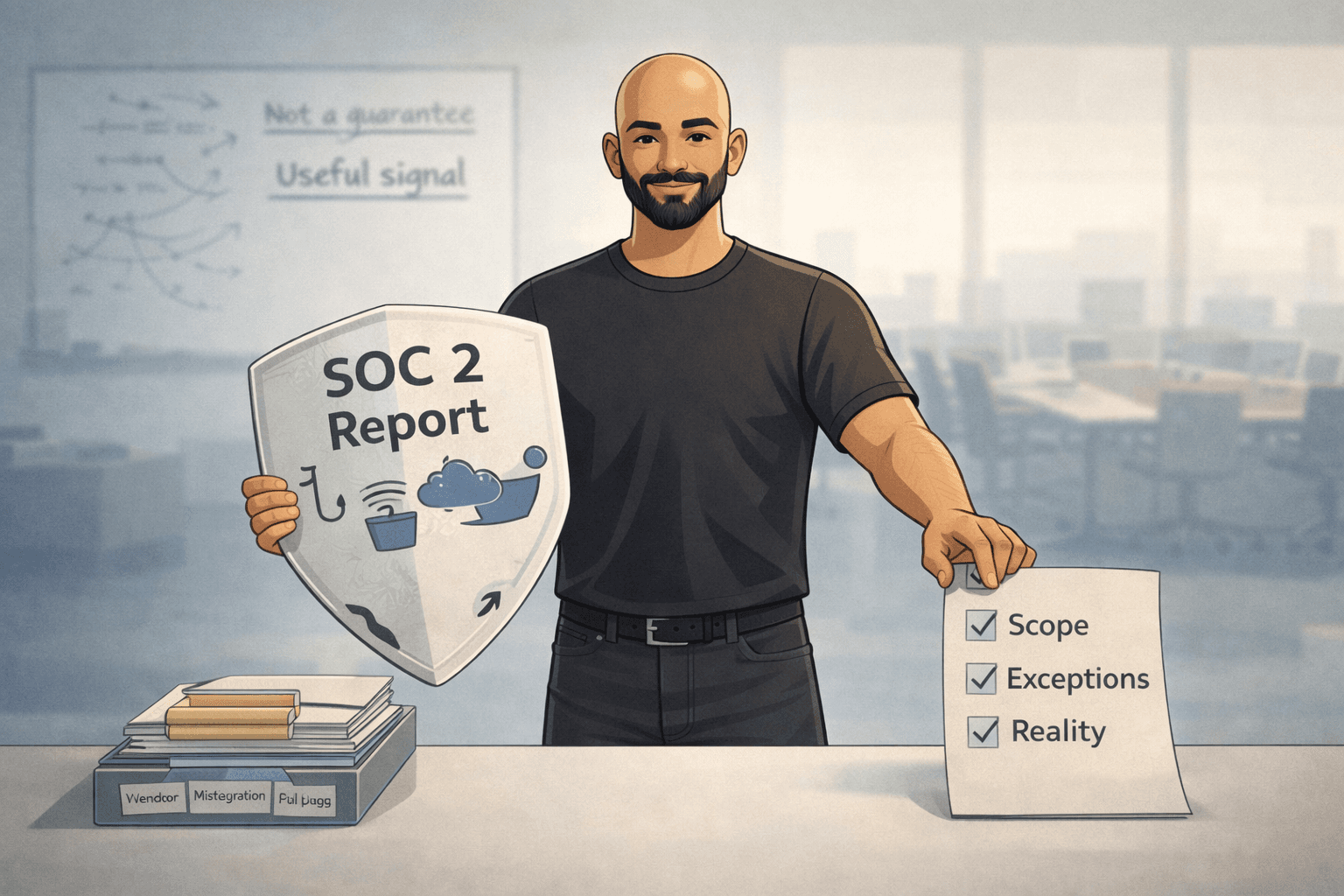
SOC 2 has become a shortcut word.
A prospect asks “Are you SOC 2?” A bank asks “Do you have a SOC 2 report?” A board member asks “Are we covered from a controls standpoint?” A founder says “We passed SOC 2, we’re good now”
And then something breaks.
Not because SOC 2 is useless. It isn’t. A good SOC 2 engagement can force discipline: documenting processes, formalizing access reviews, improving change management, tightening incident response and creating a repeatable control environment.
But SOC 2 gets misunderstood in many ways. Those misconceptions are where the risk lives.
In earlier articles in this series, the theme has been consistent: calm security is mostly decision clarity + consistent habits, not performative motion. SOC 2 sits right in the middle of that. It can be a habit-builder, or it can become theater.
This article is about what a SOC 2 report does not protect you from, and how to use SOC 2 the way grown-up security teams do: as one signal in a larger system.
Misconception #1: “SOC 2 means we’re secure”
SOC 2 is an attestation about controls at a point in time (Type I) or over a period of time (Type II), scoped to specific systems and criteria, based on testing performed by an auditor.
That’s already a lot of nuance. Here’s the simpler truth:
SOC 2 is evidence that you have a control environment. It is not evidence that you are hard to breach.
You can have a SOC 2 Type II report and still have:
-
Unpatched internet-facing systems
-
Excessive privileges in production
-
Weak detection
-
Insecure vendor integrations
-
Poor segmentation
-
Risky admin workflows
-
Users bypassing controls in practice
SOC 2 is about whether controls exist and operate. Many breaches are about adversaries finding the gaps between “control intent” and “system reality”.
One concrete example:
A SaaS company has SOC 2 Type II with strong access control policies and quarterly access reviews. In practice, engineers also maintain a handful of shared emergency credentials “for speed” during incidents. Those creds end up in a private Slack channel. A compromised account later pulls them and escalates access.
SOC 2 didn’t “fail”. The company failed to align real operational behavior with the intended control environment.
Misconception #2: “SOC 2 covers the whole company”
SOC 2 has scope. Scope is everything.
A report might cover a specific product, a specific cloud environment, a subset of infrastructure, a defined set of supporting teams and/or specific vendors.
It may not cover:
-
Internal corporate systems
-
All environments (prod vs. dev vs. legacy)
-
Newly acquired products
-
Experimental features
-
Regional deployments
-
Certain third parties (imagine if a scoped out third party handles product engineering for that company - true story)
What SOC 2 does not protect you from: being surprised by what’s out of scope.
Another concrete example:
A company shares its SOC 2 report with a large enterprise customer. The customer assumes the report covers the analytics pipeline because it processes their customer usage data. It doesn’t. The analytics stack is out of scope because it was “non-production”, built quickly and treated as internal.
Later, a misconfiguration exposes a bucket with customer usage logs. The incident response becomes awkward fast, not because the company was malicious, but because assumptions about scope weren’t made explicit.
If you’ve ever heard, “We’re SOC 2… but that system isn’t in scope”, you already know how this goes.
Misconception #3: “SOC 2 guarantees strong security engineering”
SOC 2 criteria focus on security principles (Trust Services Criteria), but they don’t automatically force high-quality engineering practices. You can pass SOC 2 with controls that are largely manual, brittle, overly reliant on “evidence snapshots” and dependent on a few key people.
SOC 2 does not protect you from:
-
Fragile processes
-
Operational shortcuts
-
Control drift between audits
This is the same idea as the earlier piece: Compliance is a snapshot, security is a habit. If your controls only work during audit season, you’ve built a cycle, not a system.
One more concrete example:
A team produces monthly vulnerability scans and remediates “critical” issues within SLA. They pass.
But the scanning coverage excludes ephemeral assets and some cloud services because the tooling isn’t integrated. The evidence looks clean. The attack surface is not.
Again: SOC 2 didn’t “miss” it. The organization optimized for evidence, not for coverage.
Misconception #4: “SOC 2 means a vendor is low risk”
A SOC 2 report can reduce uncertainty. It cannot replace a vendor risk decision.
SOC 2 does not protect you from a vendor:
-
Whose report is scoped narrowly
-
Whose exceptions matter to your use case
-
Whose subprocessor chain introduces risk
-
Whose operational reality changed after the reporting period
The most common vendor risk failure mode is simple: people treat SOC 2 like a rubber stamp.
Again a concrete example:
You onboard a vendor because they’re “SOC 2 Type II”. Their report scope covers their core SaaS platform. Your integration, however, uses a separate managed service they run for enterprise customers, hosted in a different environment with different controls. That environment isn’t in scope.
An issue occurs in the managed service. You’re holding a report that doesn’t speak to the system you’re actually using.
SOC 2 is a useful input. It is not a substitute for asking “What data do they touch?” or “What access do they get?” or “What happens if they fail?”.
That connects directly to an approach we discussed in the vendor risk article: tier the vendor, request high-signal evidence and make a decision with tradeoffs.
Misconception #5: “SOC 2 will catch fraud or insider abuse”
SOC 2 is not designed as a fraud audit. It is not a guarantee against malicious insiders. It does not prove that every privileged activity is monitored with strong detective controls. It does not prove that your finance workflows are protected from social engineering.
SOC 2 does not protect you from a rogue admin exporting data, a compromised privileged account or a business process exploit.
One last concrete example:
A company has strong policies around approvals and access provisioning. In practice, a senior admin has broad access and can create tokens, adjust permissions and export data without triggering alerts because logging is limited and monitoring is basic.
SOC 2 may test that access is restricted “appropriately” and reviewed. That’s valuable. But it doesn’t automatically mean abuse is detectable quickly.
If you want protection against insider abuse, you need:
-
Strong least privilege
-
Strong logging
-
Detective controls
-
A culture that doesn’t normalize exceptions
SOC 2 can support those habits, but it doesn’t guarantee them.
Misconception #6: “SOC 2 means we’re resilient during incidents”
A SOC 2 report often includes incident response controls. But incident response effectiveness is not the same as “we have an IR policy”.
SOC 2 does not protect you from confusion under pressure, unclear decision ownership, messy comms, poor telemetry and slow containment.
That’s why the earlier article Your Incident Response Plan Won’t Save You exists in the first place. Plans are useful. Readiness is operational.
One very last concrete example:
A company has an IRP, an on-call rotation and ticket evidence of “IR testing”. During a real incident, nobody knows whether to shut down a service because the business impact is unclear and the escalation paths aren’t practiced. Logs are incomplete, so triage takes hours longer than it should.
SOC 2 might show you have the ingredients. It doesn’t prove you can cook under stress.
So what is SOC 2 good for?
SOC 2 is best viewed as a trust accelerator and a discipline forcing function.
It can:
-
Standardize expectations with enterprise buyers
-
Create a baseline control environment
-
Force documentation and ownership
-
Move security from informal to repeatable
Used well, it becomes part of “calm security”: consistent, boring, predictable.
Used poorly, it becomes a prop.
How to use SOC 2 like an adult
Here’s a practical way to stop treating SOC 2 as a magic shield.
- Lead with scope, every time
When someone asks “Are you SOC 2?”, answer like this:
-
“Yes, SOC 2 Type II”
-
“Here’s the system scope”
-
“Here are the Trust Services Criteria included”
-
“Here are any relevant exceptions”
It builds credibility and prevents misunderstandings.
- Read the exceptions like they matter (because they do)
Most people never read the exceptions section. They should.
Exceptions are not automatically disqualifying. But they often reveal control gaps, operational inconsistencies or “we’re still maturing” areas.
The question is: do the exceptions intersect with your risk?
- Treat SOC 2 as one signal in a broader assurance model
If you’re evaluating a vendor, combine SOC 2 with:
-
Your inherent risk tiering
-
The data and access model
-
Criticality to operations
-
Your ability to enforce compensating controls (SSO, MFA, least privilege, logging, restrictions, etc.)
SOC 2 makes this easier. It doesn’t replace it.
- Build controls that are real, not seasonal
If your evidence generation requires heroics, your controls aren’t operationalized.
The calm path:
-
Automate where possible
-
Make control ownership explicit
-
Build “always on” routines
Security maturity looks like fewer exceptions and less scramble, not bigger binders.
Closing thought: SOC 2 is a floor, not a ceiling
SOC 2 can be a valuable milestone. But it’s a floor.
It doesn’t protect you from poor decisions, unclear scope, fragile processes, weak detection, risky vendor dependencies or operational shortcuts.
What protects you is boring consistency:
-
Clarity about what’s in scope
-
Strong defaults
-
Habits that keep working when nobody is watching
That’s calm security. Minus the drama.
If you want help interpreting SOC 2 reports (yours or your vendors’), tightening scope narratives for enterprise customers or building a control environment that’s operational (not seasonal), we do scoped work through Fiverr/Upwork. Or reach out to us via our website!