
There’s a moment in a company’s life when someone says: “We should probably hire a CISO”.
Sometimes it’s the right call. Often it’s a reflex.
A big customer asks for a security leader on the org chart. A board member hears “AI risk” and wants reassurance. A sales team loses a deal to “security concerns”. Or there’s an incident, nothing catastrophic, but enough to trigger the familiar cycle: urgency, meetings, a deck, a job description.
Hiring a CISO can be a smart investment. It can also be an expensive way to avoid clarity.
In the past articles, we’ve been pulling a thread: security becomes chaotic when decisions are delayed, controls become seasonal and risk gets managed through theater. The “hire a CISO” move sits right at that intersection. When done too early, it’s theater. When done too late, it’s crisis response.
This article is a practical guide to both: how to recognize when it’s too early, when it’s too late and what to do in between.
First: what people actually mean when they say “"CISO”
Different companies use “CISO” to mean different things. That mismatch creates half the pain.
Here are the common archetypes:
-
The Builder: designs the program, prioritizes, hires, operationalizes
-
The Operator: runs security day-to-day (SOC, IR, vuln mgmt, IAM, tooling)
-
The Navigator: manages risk, board comms, contracts, compliance, enterprise trust
-
The Firefighter: brought in after a fire, stabilizes and rebuilds trust
-
The Sales CISO: supports enterprise deals, security questionnaires and buyer trust
Many early-stage companies need a mix of #1, #3 and #5 before they need #2.
Many later-stage companies need #2 and #4 urgently, then wish they had hired #1 earlier.
If you don’t decide which problem you’re hiring for, you’ll hire the wrong person and call it “bad CISO fit”.
When it’s too early to hire a full-time CISO
You’re probably too early if the company cannot answer these basic questions:
-
What systems and data are most critical?
-
What are the top 5 realistic threats for your business?
-
What security outcomes matter this quarter? (not “initiatives”, actual outcomes)
-
Who owns security decisions today?
-
What is the budget, and what will it buy?
If the answer is “we’ll figure it out once the CISO starts”, you’re not hiring leadership. You’re outsourcing thinking.
Concrete example:
A 40-person SaaS startup wants a CISO because a prospect asked for SOC 2. They have no IT owner, no asset inventory, no log aggregation and engineers manage cloud access ad hoc. A senior CISO joins and spends the first 90 days doing what a security lead + IT admin could have done: finding basics, chasing access cleanup, setting up tooling, writing policies the company can’t yet operate.
The issue isn’t the CISO. The issue is mismatch: they needed a focused builder and a minimal operating model, not a big title hire.
Here are three signals you’re early:
- The role is a “symbol” more than a job
If the strongest reason is “customers expect it” or “the board will like it” that’s not a requirement. That’s optics.
Optics matter, but if you hire for optics without operational readiness, you create a high-cost figurehead.
- You can’t give them leverage
A senior security leader needs leverage:
-
Executive sponsorship
-
Budget
-
The ability to influence product/engineering decisions
-
A clear mandate
If the company isn’t ready to change priorities, a CISO becomes a professional email writer.
- You’re trying to buy maturity in one hire
Security maturity isn’t a person. It’s a system.
A CISO can build the system, but they can’t replace it.
When it’s too late to hire a CISO
Too late isn’t about headcount. It’s about exposure.
You’re late if one or more of these are true:
-
You have real customer data at scale, but no consistent access model
-
You are regularly signing enterprise contracts with security commitments that nobody validates
-
You’ve had incidents or near-misses, but response is still improvised
-
You operate in a regulated environment and audits are becoming recurring pain
-
Product velocity is now limited by security uncertainty (the “we can’t ship” stall)
-
You have multiple engineering teams and cloud environments and no unified control model
Concrete example:
A company scales from $10m to $80m ARR. Enterprise deals pile up. Security questionnaires are handled by sales ops copying old answers. Engineering makes security decisions in pockets. A vendor breach triggers customer questions and suddenly everyone discovers there is no real incident comms plan, no consistent logs and nobody owns risk acceptance.
At that point, hiring a CISO is not “strategic”. It’s overdue maintenance.
Too-late hiring has a predictable pattern, where the new leader:
-
Spends months doing emergency stabilization
-
Builds trust while cleaning up hidden debt
-
Takes the blame for decisions made years earlier
If you want a calm CISO, don’t wait until your first public incident or your first major customer ultimatum.
The middle path: what to do before you hire full-time
Most companies shouldn’t jump directly from “no security leader” to “full-time CISO”.
There’s a middle path that works well and avoids drama, and even a few options.
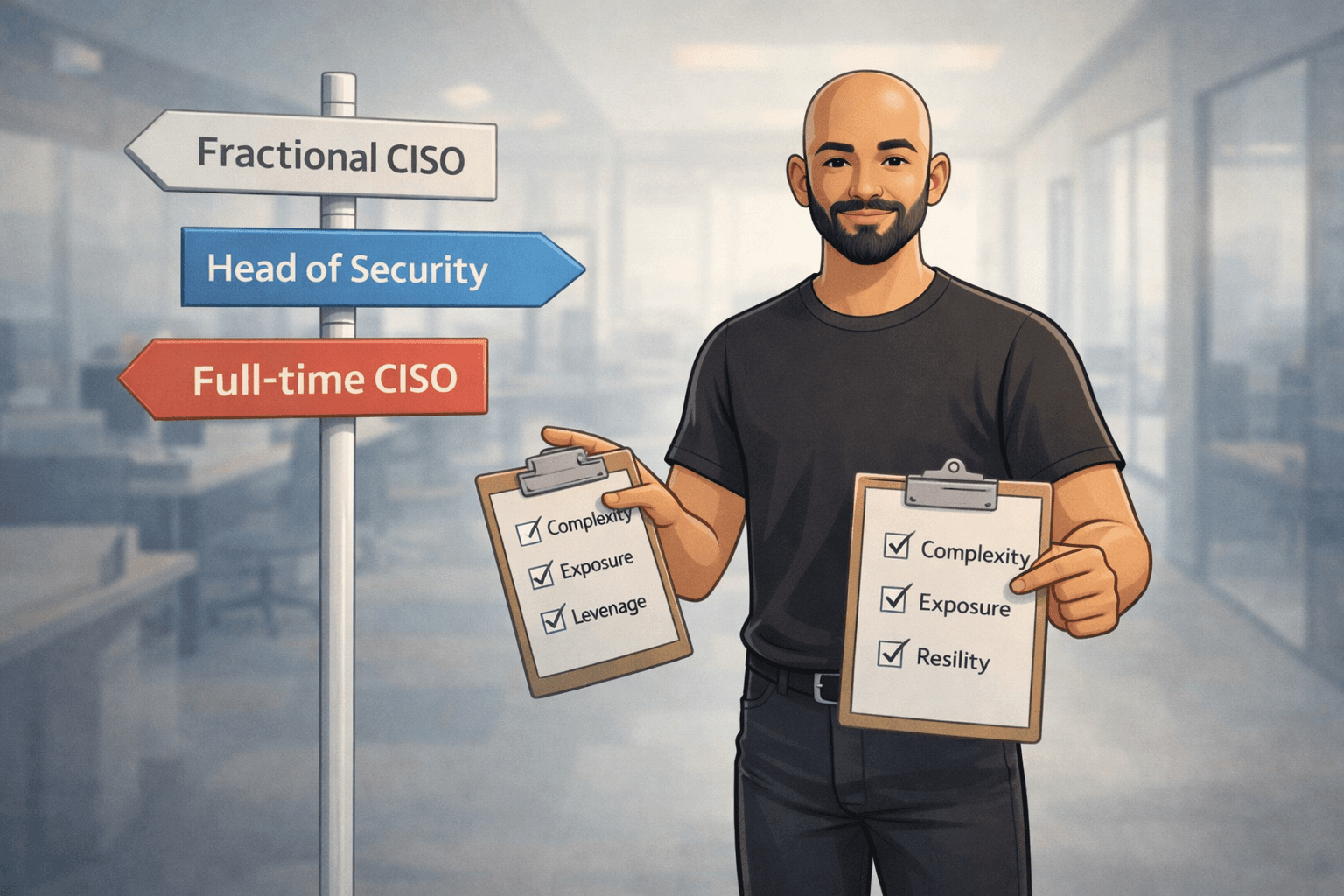
Option A: Fractional CISO (for clarity + direction)
Best when you need:
-
Security strategy and prioritization
-
A risk register that maps to the business
-
Board/customer messaging
-
SOC 2 readiness planning
-
A lightweight operating model
The deliverable is not “a program”. It’s decisions and focus.
This matches what we have discussed earlier: don’t turn answerable questions into projects. A fractional leader should produce crisp decisions, not build endless roadmaps.
Option B: Security Lead / Head of Security (builder)
Best when you need someone hands-on to:
-
Implement baseline controls
-
Stand up IAM patterns
-
Coordinate SOC 2 efforts
-
Build secure SDLC habits
-
Partner closely with engineering
This is often the right first full-time security hire.
Option C: Use a strong engineering owner + external support (early stage)
Best when you’re small but moving fast:
-
Designate a security DRI (often a senior engineer)
-
Give them time and authority
-
Supplement with targeted external expertise:
-
IR tabletop
-
Cloud hardening
-
SOC 2 readiness
-
Vendor risk process
-
Policy templates that match reality
-
This is how you build habit without bureaucracy.
A simple decision framework: the “CISO readiness” questions
If you want a practical test, use these:
1) Complexity
-
Do you have multiple products, environments or teams that need a unified approach?
-
Do you have meaningful third-party dependencies and integrations?
If yes, you need leadership sooner.
2) Exposure
-
Are you holding sensitive customer data at scale?
-
Are you making contractual security commitments you can’t verify?
-
Would an incident materially change your company’s trajectory?
If yes, you’re late.
3) Urgency
-
Are security issues blocking shipping, deals or partnerships?
-
Are audits consuming disproportionate time?
If yes, you need a builder now, even if the title isn’t “CISO”.
4) Leverage
-
Will leadership support hard tradeoffs?
-
Can the security leader say “no” when needed?
-
Is there budget to actually fix things?
If no, hiring a CISO won’t work. You’ll just burn someone out.
Common hiring mistakes (and how to avoid them)
Mistake #1: Hiring for the title, not the outcomes
A good CISO should be able to say: “In 90 days, you will have these outcomes”. If the interview is mostly about frameworks and jargon, you’re not hiring leadership, you’re hiring narrative.
Mistake #2: Confusing compliance with security leadership
SOC 2, ISO 27001 and similar efforts are important. But a compliance-only leader can leave product risk untouched if engineering leadership isn’t aligned.
You want someone who can translate compliance expectations into operational habits.
Mistake #3: Underestimating the importance of internal alignment
Even the best security leader can’t overcome:
-
No product partnership
-
No engineering buy-in
-
Unclear decision rights
-
Constant executive overrides
If leadership isn’t ready to back the role, don’t hire the role.
What “good” looks like when you do hire
Whether it’s a Head of Security or a CISO, the first 90 days should not be “tool shopping” and “policy writing”.
It should look like:
-
A clear risk model: what matters and why
-
A prioritized roadmap tied to business outcomes
-
A minimum viable control environment that’s always-on (not seasonal)
-
Clear ownership and escalation paths
-
A vendor risk process that makes decisions (not paperwork)
-
Clear narrative for customers: scope, commitments, and reality
In other words: calm security.
Closing thought: hire a CISO when you’re ready to make decisions
If you hire a CISO too early, you’re paying for a symbol.
If you hire too late, you’re paying for emergency cleanup.
The best time is when:
-
The business risk is real
-
The complexity demands coordination
-
Leadership is ready to back decisions with resources
Until then, the goal is not to “have a CISO”.
The goal is to have security leadership (clarity, prioritization and consistent habits), without drama.
If you want help assessing CISO readiness, defining the right security leadership model (fractional vs. head of security vs. full CISO) or building the first 90-day outcomes plan, we do scoped advisory work via Fiverr/Upwork and through our website.